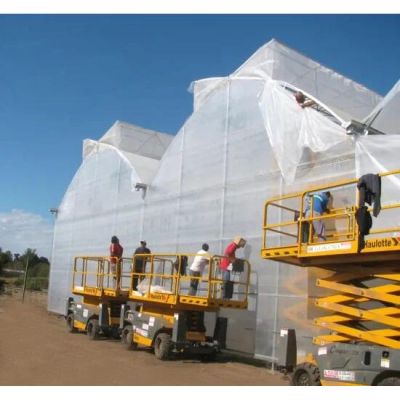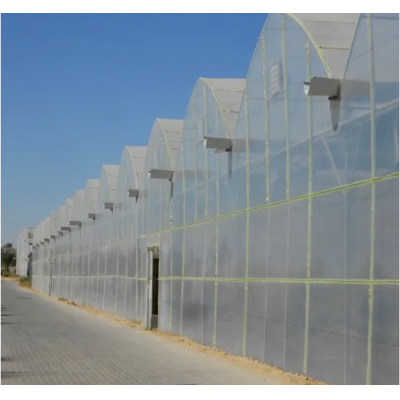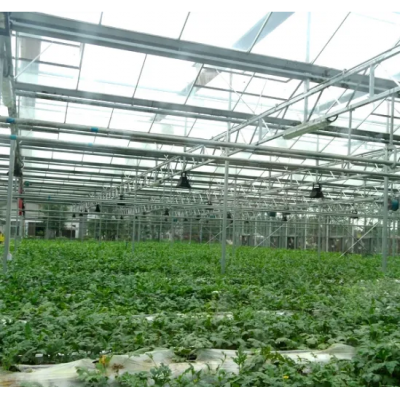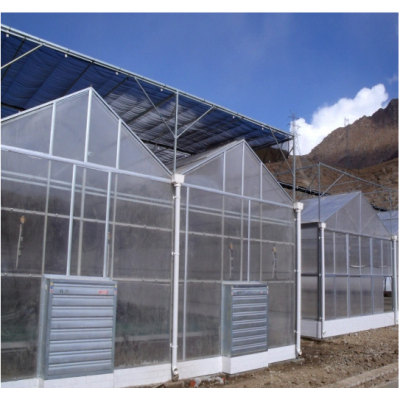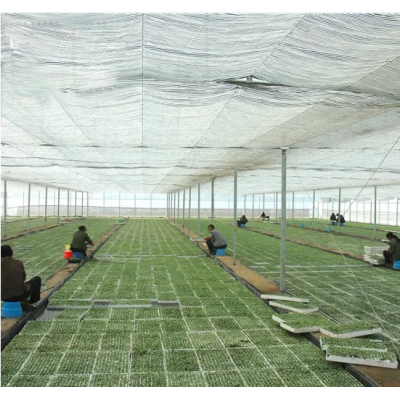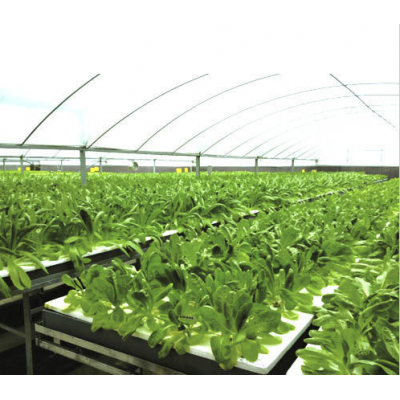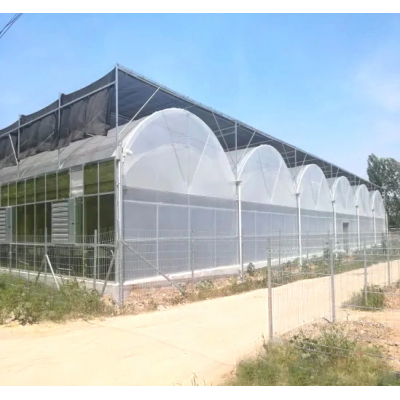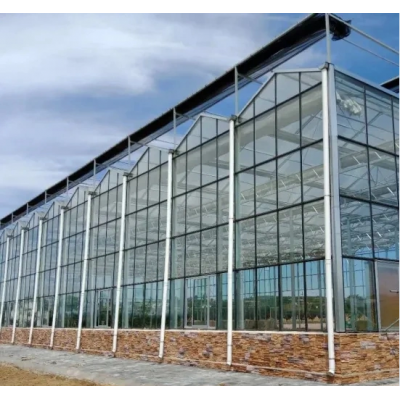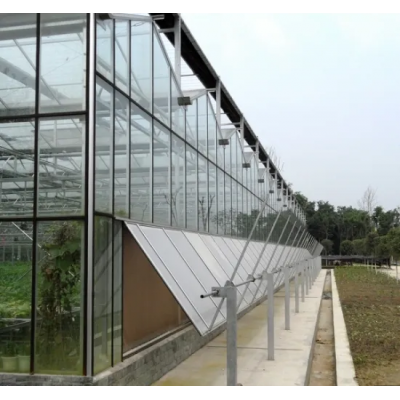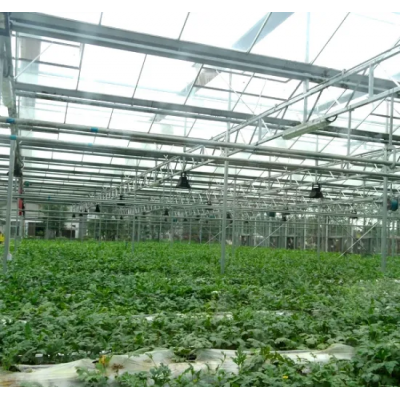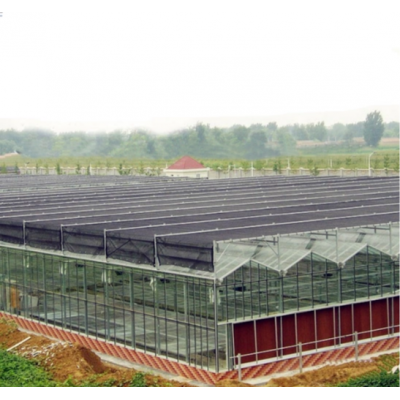
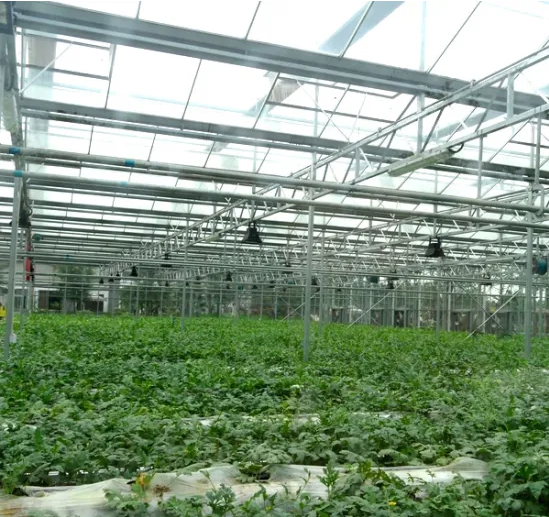
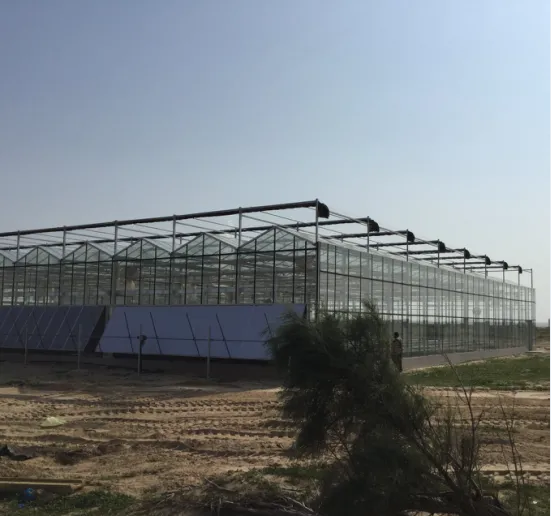
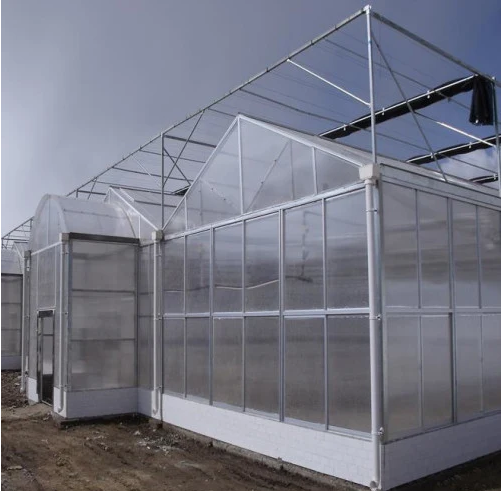
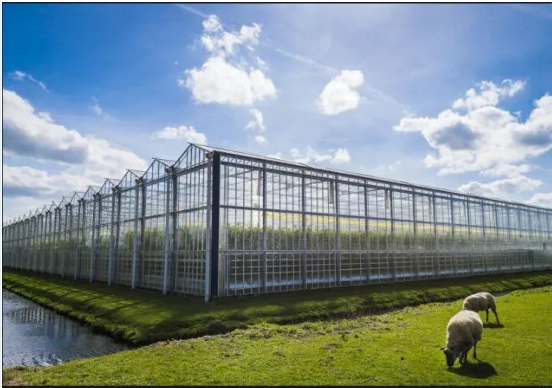
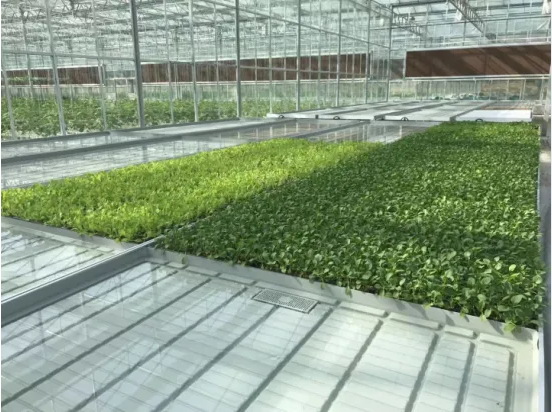
Scientific research greenhouse with glass and polycarbonate cover options on a galvanized steel frame. The multi-span layout holds one steady climate across the floor for repeatable trials, with spans of 6.4 to 10 meters and heights of 4.3 to 6.5 meters. The frame carries a 10-year structural warranty over a 15-20 year service life, with optional cooling, heating, irrigation, fertilization, shading and bench systems. Custom bay count and engineer-guided installation come standard from the Ziyang Bozong factory.

A research greenhouse lives or dies on repeatability. A trial that works in bay one but not bay three is not data, it is noise, so the structure has to hold temperature, light and humidity within a narrow band across the whole floor. A scientific research greenhouse built on a multi-span frame does exactly that - one connected volume, one climate, and the option to switch the cover between glass and polycarbonate as the experiment demands.
This glass research greenhouse uses a galvanized steel frame rated for 15-20 years of service and backed by a 10-year structural warranty, with hot-dip galvanized pipe and a grooved channel that locks the cover without clip-on parts that loosen. Spans run 6.4, 8, 9.6 or 10 meters with a total height of 4.3 to 6.5 meters, so benches, lights and sensors fit without crowding the ridge.


One climate, not several - The multi-span layout removes the walls between bays, so a single ventilation and heating loop holds the set point across the floor. Trial stations we have supplied report far tighter temperature spread than they saw in spaced single tunnels.
Galvanized steel frame - The galvanized steel frame is rated for 15-20 years of service and backed by a 10-year structural warranty. Galvanizing thickness is checked before welding, which matters in the humid, fertilized air of a working trial house.
Glass or polycarbonate cover - Choose polycarbonate research house panels for diffuse light or glass for maximum transmission; both seat into the same aluminum channel, so the cover is a spec decision, not a rebuild.
Benches, sensors, systems - Cooling, heating, irrigation, fertilization, shading and bench systems line the frame, and the ridge height clears hanging lights and instrument racks without a custom steel order.
Modular and reconfigurable - As the research program changes, bays and systems add on without tearing out the original structure. This is why stations pick a multi-span build over a fixed single house.

Designed around the precision a trial program needs, this house fits controlled-environment work rather than bulk production.

One supplier, whole structure - Frame, cover, channels and bench systems ship from one factory, so a research build does not stall waiting on a second vendor for the glazing.
Sizing to the program - Tell us your bay count, bench layout and cover choice, and we set span, height and vent positions to match. Most changes cost nothing extra at the order stage.
Engineer-guided installation - Our engineers draw the layout and can supervise on-site assembly for larger orders. This is standard above a container load, not a paid extra.
Season-committed lead times - Trial schedules do not slip, so we plan production around your start date and confirm shipping in writing. Our commercial farming greenhouse line follows the same committed timeline.
Honest limits - If your wind or snow load needs a heavier gauge, we say so before you order. The structural warranty covers parts, and researchers can cross-check crop-climate references from the ISHS or trade coverage in Greenhouse Grower.
Q: What is the lifespan of different types of greenhouses?
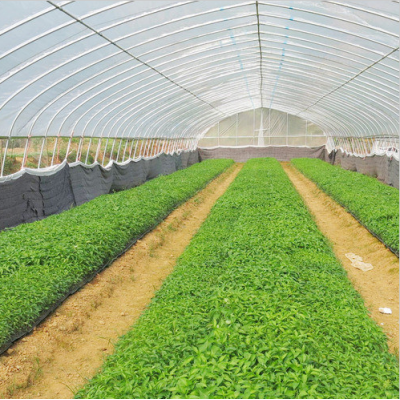
A: Up to 3-5 years for film, 20+ years for glass and polycarbonate greenhouses. Film covers require replacement every 3-5 years, while the galvanized steel frame lasts over 20 years. Glass and PC panels offer longer service life with minimal maintenance, making them ideal for permanent installations. Our greenhouse frames use hot-dip galvanized steel pipes with a double-sided zinc coating of 200-275 g/m², providing uniform, dense, and strongly adherent protection specifically engineered for high-humidity greenhouse environments and long-term corrosion resistance.
Q: How long does it take to install a commercial greenhouse?
A: Installation typically takes 2-4 weeks depending on project size and complexity. Standard multi-span greenhouses can be erected in 10-20 working days by our experienced technical team at Ziyang Bozong. On-site assembly time varies based on local conditions and project scale, but we provide detailed installation manuals and remote guidance to streamline the process.
Q: Can you customize greenhouse specifications for my farm?
A: Yes, we offer full customization including dimensions, span width, height, covering materials, and ventilation systems. Simply share your crop type, local climate conditions, and growing area requirements, and our engineering team at Ziyang Bozong will design a tailored solution that optimizes your growing environment and maximizes ROI.
Q: What is your warranty policy for greenhouses?
A: Our galvanized steel frame comes with a 5-year warranty against corrosion and structural defects. Film covers include a 3-5 year UV warranty depending on the grade selected, while glass and PC panels are covered by manufacturer warranties. Ziyang Bozong provides technical support and replacement parts throughout the lifespan of your greenhouse.
Q: What is the advantage of a multi-span greenhouse over multiple single-span tunnels for large-scale commercial production?
A: The primary advantage is land utilization efficiency. Multi-span greenhouses eliminate the gaps between individual tunnels—typically 1-2 meters per gap depending on drainage and access requirements—which can represent 10-15% of total land area in large single-span installations. This additional growing area translates directly to higher production capacity within the same land footprint. Beyond land savings, the continuous interior space simplifies equipment movement, reduces travel time for workers and machinery, enables more efficient irrigation system layout, and creates uniform growing conditions across the entire structure—supporting consistent crop quality and simplified management protocols.
Should the cover be glass or polycarbonate? - Glass gives the highest light transmission; polycarbonate diffuses light and insulates better. We help you pick once we know the crop and the climate you are simulating.
What span and height do research houses use? - Spans of 6.4, 8, 9.6 or 10 meters with total height 4.3 to 6.5 meters cover most bench and lighting layouts; tell us your rack height and we size the ridge.
Can benches and hydroponics be added? - Bench, hydroponics and shading runs line the frame, so adding them later is straightforward if the layout is left flexible at ordering.
What does the 10-year structural warranty cover? - The galvanized steel frame is rated for 15-20 years of service and backed by a 10-year structural warranty against corrosion and structural failure, with replacement parts shipped at cost.
Mark Wu, Co-founder & Lead Engineer at Ziyang Bozong Greenhouse. I have spent over a decade designing greenhouse structures for export farms and research stations, and the multi-span research builds we ship are tuned for climate repeatability, not just square metres.
Running trials in a Ziyang Bozong research greenhouse? Leave a review with your bay count and climate spread - it helps other stations plan their build.